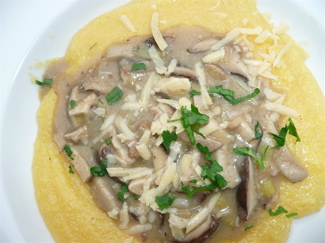
 Here in New England where it’s been gray or white, white white, my breezy old kitchen seems to shake in the winter wind, and the supply of local fare is dwindling. So it’s time to winter forage, throw a log on the fire, crank up the Billie Holiday, and cook up a warming mushroom stew.
In this case, winter foraging means driving over to Blue Moon Shrooms, which is tucked back from the road just outside Housatonic off the river. Caroline Alexander’s Berkshire Food Journal has a photo interview with owner Leslie Taft that’s well worth viewing. The pictures below are also hers.
Although the polenta was foraged too, it can be made from any coarsely ground corn. For this recipe, I used freshly ground flint corn, which was divinely corny, and purchased at a new grain CSA, Pioneer Valley Heritage Grains. It’s a cool concept, which I’ll talk more about later, as you may be interested in signing up for next year’s shares.
This is an extremely versatile recipe: Enjoy the stew without the polenta with thickly sliced and toasted peasant bread. Add more stock to make a soup or even throw it over noodles. Serve the stew as is with soft polenta or let the polenta harden, then slice, oil and grill it.
Postscript, March 2012 —I like the new variation below even better! It was made two years after the first one, when I was low on mushrooms but was still finishing my fall roots. To find this new variation, scroll down to the end of the screen: It’s posted in green.
Makes 2-3 main course servings, but easily doubled or tripled.
For the Stew
4 dried shiitake mushrooms or 1-1/2 tablespoons dried mushroom powder
3⁄4 lb shiitake mushrooms, stems removed, sliced
About 1/4 cup oven or sun dried tomatoes, (optional)
1/2 cup chopped leeks
2-1/2 tablespoons butter
1 teaspoon fresh thyme leaves or more, to taste
2-1/2 tablespoons flour
2 cups chicken or vegetable stock (or combined water and stock)
About 2 tablespoons dry sherry or Madeira
Salt to taste, if needed
Freshly ground pepper taste
About 3 tablespoons coarsely grated hard Parmesan-style cheese, preferably local
Chopped parsley leaves, optional
For the Polenta
3/4 cup yellow cornmeal, preferably coarse
2 cups chicken or vegetable stock (or combined water and stock)
1 garlic clove, minced
1/2 tablespoon butter (optional)
1/4-1/3 cup coarsely grated hard Parmesan-style cheese, preferably local
1. Soak the dried mushrooms in hot water to cover. When they are soft, drain, rinse and chop the mushrooms. Reserve the strained soaking liquid and the mushrooms together. If you are using mushroom powder, soak it in about 1/4 cup water and reserve. If you are using the optional oven dried tomatoes, soak in hot water until soft, Drain and slice thinly. Reserve.
2. Cook the mushrooms and leeks in the butter, in a medium non-stick pot or skillet over medium low heat, stirring frequently, until the leeks are wilted but not brown, about 3 minutes. Add the thyme and flour. Reduce heat to very low, and cook, stirring constantly, scraping the bottom of the pan with a wooden spoon, for about 2-3 minutes to cook the flour.
3. Turn the heat to medium. Pour in the stock, whisking as you pour. Add the Madeira or dry sherry, dried or powdered mushrooms and their liquid, the tomatoes, if you are using them. (If you aren’t using homemade or low-sodium stock, substitute 1/4 cup of it with water to hold down the salt.) Simmer on a low heat for about 20 minutes, or until the texture of a thick soup. Season with salt, if needed, and freshly ground pepper to taste. Add an extra splash more of Madiera or sherry if you like.
4. Cook the polenta while the stew is simmering. Add 2 cups stock and one 1 cup of water, the garlic and the cornmeal to a small non-stick pot. Bring to a boil and reduce the heat to low and cook, whisking occasionally it begins to thicken. When the cornmeal starts to pull away from the sides of the pot, about 10 minutes, taste and add salt and pepper to taste, if needed. (If not serving immediately, hold in a double boiler, stirring frequently to prevent lumps and adding water if necessary.) Before serving, stir in the butter, if you are using it, and cheese to taste.
5. To serve. Add the polenta to the bottom of a warm shallow bowl. Make a hole in the middle, then add the stew to it. Sprinkle with the reserved cheese and parsley, if you are using it. Serve immediately.
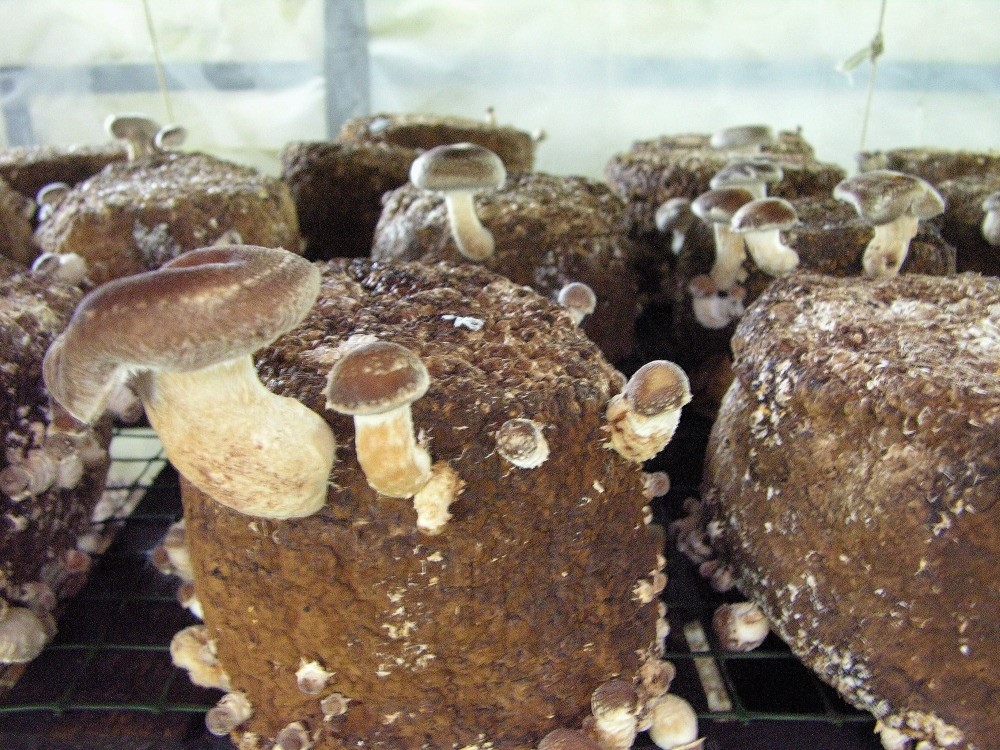
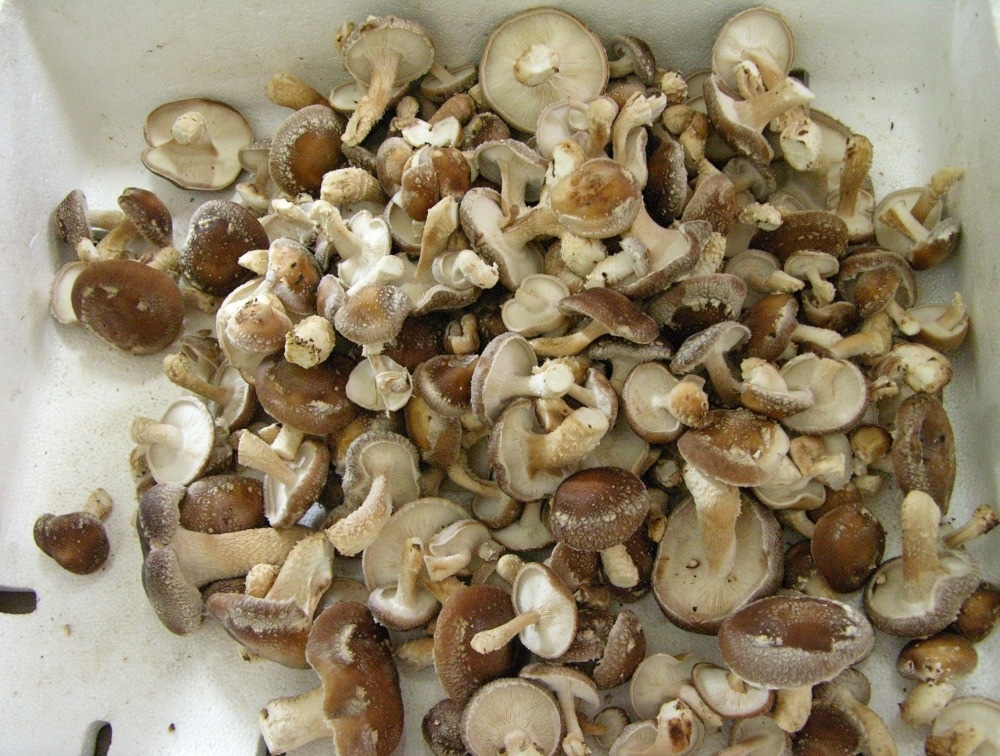
Update: The mushroom grower in this piece, Leslie Taft of Blue Moon Shrooms, is going out of business. Happily, she looks forward to moving to Maine, but it is tragic that the steep competition from the agri-business has lost us both local mushroom growers. This is the common story for small farmers: Leslie had more customers than she knew what to do with, but couldn’t really charge a fair price for her mushrooms and still stay competitive. And so we lose another farm.
More sad news for locavores: The supreme court and food politics on Marion Nestle’s excellent blog.
Postscript: Two years later, March 2012.
Mushroom Stew with Winter Roots on Polenta
This is a revised version of the recipe above that I enjoyed even better! It makes 8 main course servings, so is great for company, who insisted on the recipe.
Stew
1¾ lb shiitake or any kind of wild mushrooms, stems removed, thinly sliced
3 leeks, chopped (whites only)
1 tablespoons olive oil (or half oil and half butter)
4 tablespoons sweet butter, local if you can find it
1 tablespoon fresh thyme leaves
½ cup flour
3 tablespoons Madeira or dry sherry, or more to taste
1 potato, pealed and cut into a tiny dice
1 small sweet potato,peeled and cut into tiny dice
1 medium celery root, well pealed and cut into a tiny dice
About 1 quart chicken or vegetable stock or more to reach desired consistency.
salt and pepper to taste
Chopped parsley leaves
3 tablespoons Parmesan-style or any local aged cheese, optional
Polenta
8 cups water
2 teaspoons salt
2 cups cornmeal (I prefer coarse)
1/3-1/2 cup grated Parmesan-style or any local aged cheese, optional
1. Cook the mushrooms and leeks in the olive oil and butter in a medium non-stick pot or skillet over low heat, stirring frequently, until the leeks are wilted but not brown, about 3-4 minutes. Add the thyme and flour. Cook, stirring constantly, scraping the bottom of the pan with a wooden spoon, for about 2-3 minutes to cook the flour.
2. Turn the heat to medium. Pour in the Madiera or dry sherry — I prefer the former — stirring as you pour. Add the potato, sweet potato and celery root and 3 cups of the stock. Simmer on medium-low, adding the remainder of the stock as needed to marry the flavors, cook the roots and reach a thick stew, about 20 minutes. Season with salt, if needed, and freshly ground pepper to taste. Add an extra splash more of Madiera or sherry if you like.
3. Cook the polenta while the stew is simmering. Combine the polenta, water and salt. Bring to a boil and reduce the heat to low and cook, whisking occasionally it begins to thicken. Simmer, stirring occasionally, until the polenta starts to pull away from the sides of the pot, about 10-15 minutes. Before serving, add the cheese, then salt and pepper to taste. (If not serving immediately, hold in a double boiler, stirring frequently to prevent lumps and adding water if necessary.)
5. To serve. Add the polenta to the bottom of a warm shallow bowl. Make a hole in the middle, then add the stew to it. Sprinkle with the reserved cheese and parsley, if you are using it. Serve immediately.